
WOOD WIDE WEB
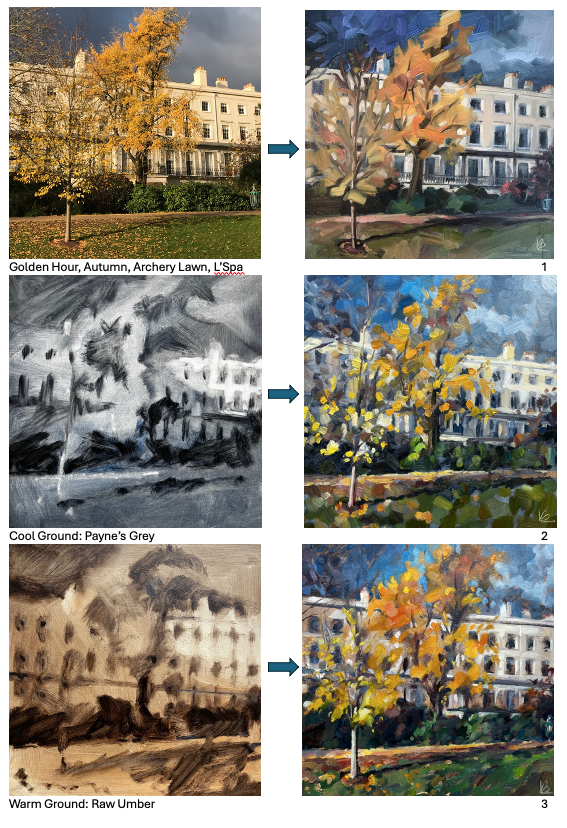
Here are some different interpretations of the same landscape. I took the reference picture in a park close to my home in Leamington Spa. The buildings are typical of the regency style of architecture around the town centre and the trees were glowing in the golden hour light against an indigo blue sky.
I’m going to use these paintings as the basis for a landscape painting workshop so here’s a snippet of what I’ll be discussing on the day…
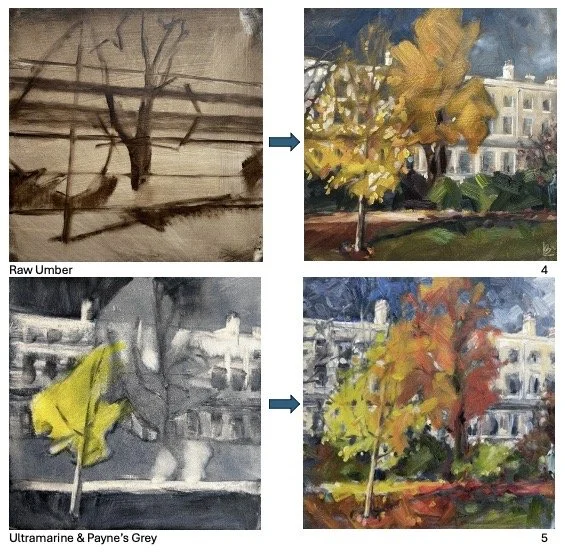
“Comparing the paintings numbered 1-5 (below) in order of their creation:
No.1 has no tonal underpainting and has been painted with flat brushes.
No.2 had a cool tonal ground to tie in with the sky colour. There are a nice variety of blues in the sky.
(No.s 2-5 have been painted with a small and larger filbert brush- curved end -hog haired for texture).
No.3 ( my favourite ;) has a warm tonal ground to tie in with the land and the light. I like the ‘un-doneness’ of the building in this one, the light falls correctly - illuminating the top right hand corner. The colours and shapes feel well balanced.
No.4 begins to explore how to use the tonal sketch to form the skeleton of the tree, and really leans into the contrast of: the solidity of the larger- warm yellow tree, compared to the transparency of the smaller- cool yellow tree.
No.5 continues to explore the use of the tonal sketch to form the skeleton of the tree, letting the first layer dry then putting thin transparent glazes of colour over the top so the skeleton of the tree remains visible. The painting began to take on a life of its own at this stage. It became more about movement and the intensity/ purity of the colour. The trees lean towards each other, the path between them is illuminated. As in nature, the trees in the painting somehow feel like they connect above and below ground level (see notes on ‘Wood Wide Web’ below).
It would be impossible for me to have made the leap instantly from 1-5 and in fact they are a few years apart in terms of their creation …. Your ideas need time to develop so don’t be afraid to paint a scene multiple times and see how it evolves. Vary your surface / medium / brushes / approach, remain open - maybe it will surprise you!
Wood Wide Web
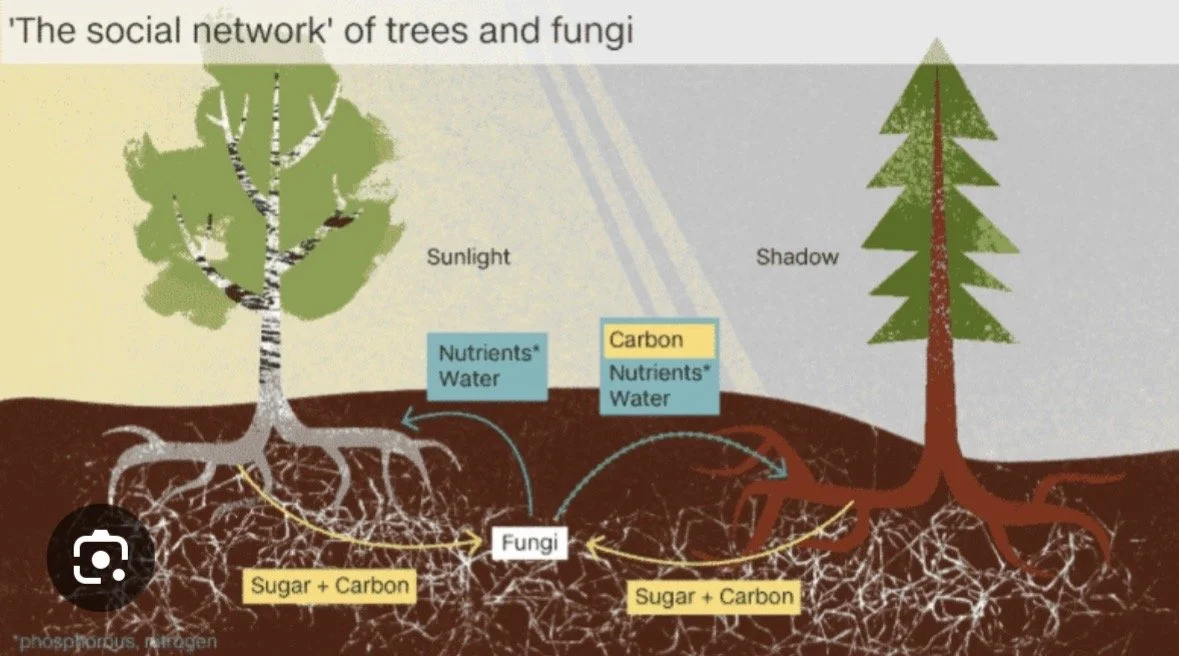
Trees communicate and share resources underground through a complex, symbiotic network of fungi known as "mycorrhizal networks" or the "wood-wide web". This network connects tree roots, allowing them to exchange nutrients, water, and chemical signals to warn neighbors of threats like pests or drought.
How the Underground Communication System Works
The Network: Microscopic fungal threads, or mycelium, connect the roots of individual trees, even across different species, forming a massive, interconnected web under the forest floor.
Symbiotic Exchange: Trees transfer carbon-rich sugars produced via photosynthesis to the fungi, while the fungi provide the trees with essential nutrients like phosphorus and nitrogen absorbed from the soil.
Resource Sharing: Older, larger "mother trees" can use this network to supply shade-grown seedlings with necessary nutrients to increase their survival.
Defense Signaling: When trees are attacked by pests or face drought, they can send chemical warning signals through the fungal network, alerting neighboring trees to raise their defenses.
Wood Wide Web